


Mindfulness & Mental Health | A Talk with Tori Ramsdell
- David Connor

- Jul 2, 2020
- 13 min read
Updated: Apr 28, 2021
Today I am joined by a 200 hour registered yoga instructor and all-around delightful individual, Tori Ramsdell, to discuss the benefits of mindfulness practices and the healing of mental health!
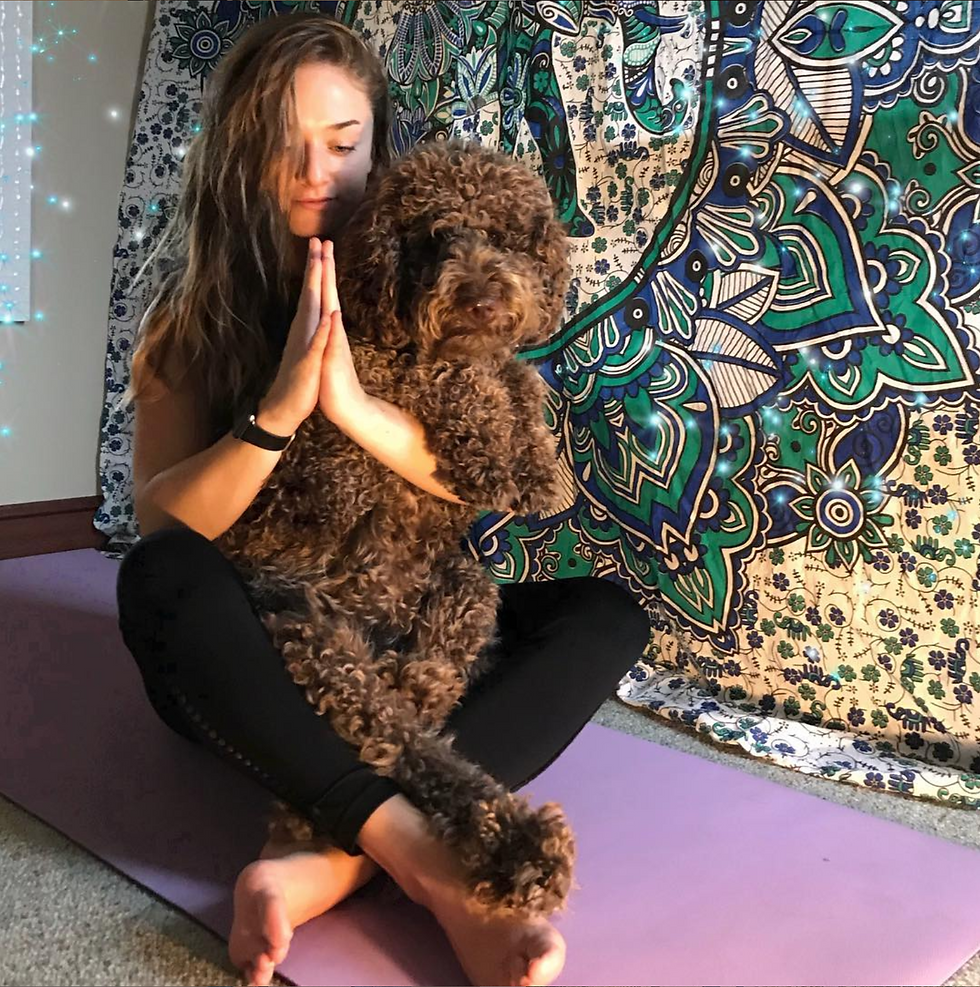
Flex Yoga Studios - Tori Ramsdell
Classes Monday and Friday @ 9:30 am.
Follow her! @tori_ramsdell
David:
I understand that you're journey of adopting these practices arose from the suffering of mental illness. What made you interested in yoga, and what inspired you to become an instructor?
Tori:
College was an awakening for me. I'm a small-town girl, and I soon realized I had a small-town brain. My life was flipped upside down and I quickly came to educate myself and morph into the person I wanted to become. Not the person influenced by the environment I had been in my entire life. Depression and anxiety set in from 1. being in college and 2. the deep realization that I wasn’t proud of the person I was and wanted to grow and change myself for the better. This is where yoga comes in. I basically started more for the benefits of the mind. I started watching Yoga With Adriene online and quickly fell in love. I started doing her videos daily and noticed big and small changes. In my mind, my body, my heart... Once I was able to get that mind-body connect and really link my breath with the movement, it all made sense. My anxieties are faded because when they arose I knew I could breathe through it. I had already practiced a million times on my mat, why not in real life?
After earning my degree, life sent me back home. This is where I stumbled upon my first in-class yoga sessions, right here at Flex Yoga. I immediately was even more addicted. There's such a benefit to in-studio training when it's available and in your budget. The teachers here improved my practice and enhanced my love for yoga by a million.
My good friend and past instructor at Flex inspired me to become a teacher myself. She explained that it's such a journey into self-study among many other things and I was sold. Mainly because yoga already aligned with my heart and soul. It just clicked.
See, often times when you're on your mat you're met with your "edge." The moment right before giving up. The moment of utter presence and awareness. Meeting my "edge" on my mat gives me practice for similar circumstances in life. My 200 hour taught me yoga is literally a way of life. It's a life principle. I carry out the practice in every single thing I do. Every interaction.
I'm a firm believer that every interaction you have with another person has impact on their life. Changing the world starts small, it starts with every interaction. I want to treat others with the utmost respect and kindness even in adverse situations. But I will also stand my ground and speak up when needed. I guess what I'm saying is... there's a lot of sadness, hate, and negativity in the world. I want to do my part to actively help change that, and that begins every day for me. I spend some time in the morning scanning my mind and my body and noticing how I feel. I take that as knowledge that helps me in those interactions with others throughout the whole day. Whether I am stressed, tired, or sore, I still want to handle myself with compassion and steadiness. I try not to be reactionary. Living solely in the moment without worry of the past or stress of the future, and being 100% real and kind.
I also really want to help others find this sort of "mind control" I've experienced. We control literally everything in our lives. It comes down to outlook. It's easier said than done, believe me, but that's where the practice comes in. Yoga and meditation actively allow you to practice this control over the mind and the body. This can have drastic impact on the body overall! Stress hormones go down, breaths deepen, mind slows... it's science! As cavemen, our fight-or-flight response was needed because of immediate danger (ex: tiger). When we are faced with danger our sympathetic nervous system takes control, hormones boost through the body, heart rate increases, we stiffen, our vision narrows, yet as a caveman the danger stops. The tiger stops chasing you. Today, we don't face immediate life dangers the same way we did back then. For the most part our stress and anxiety isn't even physical. And that's why we see anxiety becoming more chronic; our brain can't make sense of the continuous stress resulting from how we can't physically see that tiger stop chasing us. You can literally switch the parasympathetic nervous system back on with control of the breath. Once I experienced that for myself and was able to stop anxiety in healthy ways (breath control, mindfulness, etc), everything changed.
David:
You're description of the "edge" gave me chills. I can relate to that feeling very deeply. I used to be a huge fan of twenty one pilots and there's a song with these lyrics that hit me hard and relates pretty well to all of this:
Remember the moment, you know exactly where you're goin'
cause the next moment before you know it
time is slowin' and it's frozen still
And the windowsill looks really nice, right?
You think twice about you're life, it probably happens at night, right?
Fight it. Take the pain, ignite it.
Tie a noose around you're mind, loose enough to breathe fine and tie it
to a tree, tell it "you belong to me.
This ain't a noose this is a leash
And I have news for you, you must obey me."
Like you said, there definitely seems to be a symmetry in the relationship of mind and body. It explains a big aspect of how exercise improves mental health. I think it has something to do with learning to overcome discomfort by teaching your mind perseverance through pushing your body to its limit. If I’m running, and I reach that point of exhaustion on the "edge," I can often tap into a new source of energy that comes from the dedication to overcome that obstacle. So, I’ll go from jogging exhausted and sluggish to suddenly start running like a madman. It hurts so much, but I’ll never feel so alive as in those moments. It helps me transcend mental suffering by coming head to head with it. And afterwards, my mind recognizes that it’s stronger than it thought. So part of breaking the cycle of depression for me had to do with making that first, painful step to move my body so that my mind could follow and grow stronger too. The same principle seems to apply to these other methods of regulation such as yoga, which literally means “discipline/control.”
I did some looking into that book you mentioned you were reading, “The Body Keeps the Score” and thought it was fascinating how psychiatry and therapy has been treating mental health from a reductionist perspective, where we focus on treating the symptoms of these illnesses with pharmaceuticals on a mass-scale rather than getting to the source of what are often very unique and complex underlying issues. It suggests that, instead, we can actually harness the power to regulate our own physiology through breathing, moving, and touching. All of these things center around "reactivating a sense of self, the core of which is our physical body." And that leads into the benefits of mindfulness! It does exactly what prescriptions can never succeed at by giving us the tools necessary to “know what we feel and understand why” so we can get to those internal sources of suffering and re-design our own mental space. Like you said, you can find a sort of “mind control” through these practices. That book explains how the wonderful thing about our brain is that it doesn’t know the difference between imagination and reality. So, imagination, creativity, and perspective seems to also play a role in how we can dream a better dream, so to speak. It makes me think of the teachings of the Yogachara (yoga practice) tradition. Basically, they state that “everything is perception and all imagery is a projection of the mind’s interpretation.” Our experience of the world is constructed in the mind and is thereby limited by the way the mind constructs it. It basically boils down to this main concept about outlook: “Control your mind— control your reality.”
And as you mentioned, there’s a lot of sadness, hate, and negativity in the world. It’s so easy to become a victim to that reality and feel hopeless, like you’re at the edge. But when we put that energy, instead, into actively trying to improve it, our whole perspective on that reality begins to change into something much more hopeful. The positive subtleties of life become much more apparent. That hopeful energy multiplies as we grow through it and become more capable of facing resistance.
The fight or flight response to non-physical stressors you’re referring to sounds very problematic. How does this relate to your experience with dissociation? “The Body Keeps the Score” mentions how this reaction to overwhelming emotions hinders a person’s capacity to feel fully alive. How can mindfulness help to re-organize this sort of mental fragmentation of experience that occurs with dissociation? And in the healing process of re-activating a sense of self by finding a way to be fully alive, in the present, and engaged with others, what do you think it means to become “fully alive?” You also mentioned handling yourself with compassion and steadiness. Do you have any advice on how someone can nurture that sort of patience and self-love?
Tori:
I think you have a pretty good grasp on basically everything I’m talking about. Which I could tell when we had that conversation the other day. So I very much agree with and like everything you just said. It’s all true. Funny how the government LOVES suppressors. Loves it’s people addicted to opioids and stuff that makes you blind and numb.
As far as handling myself with compassion and steadiness... it takes practice. We literally work in a stress environment, a restaurant. People lose their shit sometimes. It's EASY to take your stress out on others. It's EASY to snap under pressure and say something you didn't mean. It takes control to take a step back from whatever situation is giving you stress... to look at it from above... maybe that's a kind of dissociation too.
Maybe it’s because I’ve experienced trauma, and know in my soul that my interaction with a person has deep effects. I don’t want ANYBODY to hurt the ways I’ve hurt, especially because of me. I approach everybody like they have their own journey and struggle that I don't know about. Because they do. Often times as humans we believe we're nothing more than ourselves and the interactions we have. We forget that those interactions travel into somebody else's life and mind.
It takes practice. Like I mentioned, I'm not proud of the person I used to be. I did the opposite of everything I'm saying. I was fucking hurt, so I hurt people. I was the bully and the victim. I was... ugh. Makes me think of one of my favorite songs by Paramore called Caught in the Middle:
I can't think of getting old
It only makes me want to die
And I can't think of who I was
'Cause it just makes me want to cry, cry, cry.
Can't look back, can't look too far ahead
Another lyric hits hard later:
No I don't need no help I can sabotage me by myself
Basically, I know our own worst enemy is our own brains for the most part. So why add to that? A couple things that help:
The practice itself is humbling, it's a self-study. You can see how constantly practicing yoga and meditation can literally have an effect on everything, even how you treat others.
I always, always approach each person with one intention: learn. Each person I meet is an expert at something. Each person I meet can teach me a million things. Yet if I approached them the opposite, I would never know this. And I think a lot of people approach too hard with ego.
Remember that everybody has their own pain they're dealing with, as mentioned earlier.
By the way, yes, the book on trauma is so fascinating. Funny how we all deal with it... trauma, death, stress, pain, yet we know so little about it still as Bessel mentions in the book. We know more now of course but, just think, we all deal with death and grief at some point in time. Why doesn’t everybody know how to deal with it or somebody going through it then? We just don’t. Not everybody cares about the processes of the mind like this. So many people suppress.
Simple, "fully alive" is presence. It’s the act of being 100% present and aware. Looking up from the phone and noticing the earth and it’s beauty around you. Not drifting into your own head when somebody is talking to you. Being here. In the present. I practice this when I wake up. I try not to grab the phone. I wake up with my buddy, my goldendoodle, Kona. It’s so easy to practice this on a dog because animals are 100% present. They give you their all literally all of the time. I’ll wake her up letting her know how much I love her. Lots of pets and kind words. I feed her; she’s got a stomach problem which basically requires me to be present while feeding her. I can’t just set the food down and zone out, I pay attention. I walk her with intention. I let her outside with intention. I feel her fluffy little poofy head and think about how short her life truly is and how I want her to know the best parts of me. I want each moment to count. I try not to pet her while doing something else (like being on my phone). I pet her with all of my attention and intention. I’m aware in those moments.
As far as my experience with dissociation, it’s my belief that most of the time it’s a learned response from trauma. It states multiple times in “The Body Keeps the Score” that often, people who have dealt with trauma will push it down in order to survive it. Not everybody can “live” with the terrible thoughts and memories of the past, so the brain literally throws it away. It usually comes back up though, obviously, that’s where flashbacks come from. Anyway, I think if you have practiced this throughout your life; dissociation, or literally leaving your body and brain whenever you can’t handle your current circumstances... makes you very good at it.
Mindfulness does a good job of snapping you back into reality. Because to put it in basic terms, dissociation is the opposite of being present. You’re literally not in the moment; you’re gone, somewhere else. But, using tools like breath control can bring you back to the body. It can stop the clutter in the head. It can calm the stress hormones. Meditation. Actively practicing bringing yourself back to reality. Naming five things you can touch, hear, smell etc. Breathing in for counts of 4, holding full, and extending the exhale as long as possible. Taking a deep sigh. All of this literally helps it trigger and tell the body that you couldn’t possibly be worried if you just took a deep breathe. The body is easily fooled by the mind.
David:
I think you’re right, our society loves suppressors: alcohol, opioids, benzodiazapines, antidepressants, etc. These chemicals don’t only dull the feeling of pain, but also all sensation. And it’s like our culture promotes mass dissociation as a means of coping. It makes us a lot easier to control when we lose our sense of “aliveness.” What I find really fascinating about the recent, groundbreaking studies about the treatment of mental illness through psychedelic medicines is that they act completely differently than traditional treatments. Instead of using pills that dull sensation, it seems these chemicals, in a therapeutic setting, provide not a simple cure to symptoms but rather offer an opportunity to look within and personally remove those mental blockages. For example, the treatment of trauma and PTSD has been extremely insufficient with our current practices. The thing about traumatic memories is that unlike positive memories which have a beginning, middle, and an end, these memories are disorganized and fragmented. PTSD is where the body is continuing to defend against a threat that belongs in the past. So, that fight-or-flight response continues to be activated just thinking about that tiger, which makes it extremely difficult to mentally confront. However, there is a lot of hope in the therapeutic potential of MDMA: the high-dopamine, high-serotonin, and high-oxytocin state assists the mind in experiencing a fully open and trusting environment through which trauma can be explored and confronted, not through suppression, but through an embracing of all sensation. It quiets the amygdala, removing the burden of that fearful, survival instinct. That book says that the key to trauma treatment is helping clients “befriend, not suppress, body energies needing to be released.” All these practices seem to center around this very concept: Sensation, not suppression.
You say that taking a step back and detaching from stressful situations can improve our sense of steadiness. It does sound like a form of dissociation, but it’s almost like instead of becoming randomly fragmented and disorganized, there’s an intention to stepping back that lets you see things more clearly. Like you said, presence is the opposite of that. Understanding that the past and future exist somewhere else that can never be here and now. “Can’t look back, can’t look too far ahead.” The Sautrantika doctrine states that everything is in a constant state of becoming. Neither past nor future are real. As things pass away, they do so only because something new has come to be. That book mentions that “Most human suffering relates to love and loss, so the therapist’s job is to help people acknowledge, experience, and bear the reality of life, with all its pleasures and heartbreak.” There’s a bitter-sweetness to it, but I think recognizing the perfection hiding within the flaws of life is the experience of true beauty. I mean, what could give life more meaning than the embracing of its temporary nature?
I love what you said about how you encounter people with an intention to learn. You’re talking about something I’ve been really fascinated by in my studies of communication. In fact, I was just writing for another blog post that deals with that exact subject; rather than being an ego that approaches the other as an object separate from itself, we can encounter and experience a fellow subjects whole being without filtration through our mediated consciousness, with its litter of preconceptions and projections, to experience a sacred space Martin Buber calls “the Between” where we can discover and embrace our true identities through the recognition of a deeply mutual condition. The place where genuine dialogue blossoms, where we experience the “real” stuff of existence: “All real living is meeting.” It’s an approach that dissolves the boundaries of separation.
I like your definition of being “fully alive” as 'presence.' Like I mentioned before, I’m pretty ADD, and I have a loud internal dialogue that I often feel little control over so I’m definitely guilty of what you said about drifting into your own head when someone is talking to you. It really is important, though, and I know it’s something I need to work on.
You gotta love dogs, they really are just happy to be right here, anywhere. It’s beautiful how you put so much intention into that relationship and I can see how it can positively impact your overall perspective.
Thanks so much for sharing your thoughts. I think a lot of this stuff about mindfulness comes down to learning to accept, love, and embody our own experience. As we tap into our sensations, we become grounded in the moment and notice the subtle beauties of it. We pay close attention to our movements, our impact on our surroundings, and notice how this is a fundamentally interactive experience that requires an absolute presence to be fully alive in it. And once we nurture intentional and loving interactions, we recognize the positive influence our existence is creating. We catch a glimpse of our own reflection, and discover how we can find love and acceptance for that being in the mirror.
Do you have any final thoughts you’d like to share with the world? Maybe a quote that deeply resonates with you or a piece of advice that, when applied, could improve the personal lives and mental health of our readers?
Tori:
Yes! Exactly! Agreed with everything. To anybody struggling, know that every feeling is temporary. I know how permanent some sensations can feel but literally nothing is permanent. The journey is day by day. If you can just take it one day at a time, it's a lot easier for your brain. It makes me think of this reading from the Book of Awakening by Mark Nepo:
"Like clouds moving in water, problems make me forget I am clear."
At the end of the day, we are clear.


Comments